
Featuring the Alfresco Collection by James Dunlop

Journal

Airlie colour Oyster by James Dunlop | Image courtesy of Tait & Country Road

Noosa colour Sky Blue by James Dunlop | Image courtesy of Tait

Noosa colour Limoncello by James Dunlop | Image courtesy of Tait
Innovative yarns | Recycled Olefin
Soft and strong, olefin (also known as polypropylene) is a preferred textile for outdoor use due to its durability, cleanability, and colourfastness.
The virgin and recycled olefin production processes use less energy and water than those used for other synthetic fibres, and both textiles are 100% recyclable at their end of life.
As olefin is resistant to UV damage, abrasion, stains, and mildew it does not require frequent washing and due to its low ability to absorb moisture, it will dry quickly after washing or exposure to water. Additionally, olefin is a strong fibre that is long-lasting and less prone to tearing or stretching over time.
Pleasant to touch and available in a wide variety of structures and weave patterns, we’re excited to be utilizing recycled olefin fibres in James Dunlop’s expanding outdoor range, the Alfresco Collection.
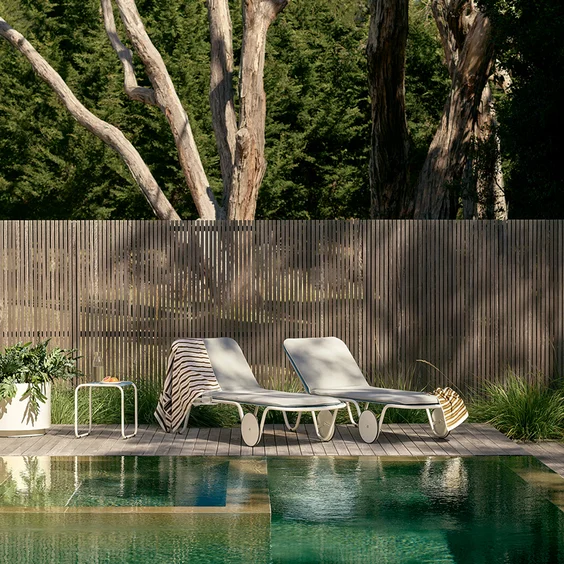
Alfresco Collection by James Dunlop | Image courtesy of Tait
The science of olefin
The science of olefin
A by-product of the petrochemical industry, olefin is a synthetic yarn created by Nobel Prize-winning Italian scientists Guilio Natta and Karl Ziegler in the 1950s.
Olefin is referred to as an upcycled product as it is made from propylene gas which, prior to the invention of olefin, was burnt off during oil production. It is manufactured through a process of polymerization which uses titanium as a catalyst; this means that singular molecules (granules) are linked to form a chain of repeated structural units.
This chain is then melted at an extremely high temperature and colours are infused into the polymer, achieving the superior colourfastness olefin textiles are known for. To spin the resin into yarn it is extruded through a spinneret composed of small holes and elongated by applying external tensile force, as the resin is pulled it is cooled, resembling a glass rod which can be manufactured into yarn.
The olefin recycling process
The olefin recycling process
Pre-consumer olefin textile waste including fibres, yarns, flawed fabrics, and off cuts are collected from the mill’s own stock as well as from a local company who provide textile waste storage services on a global scale.
Once collected, these waste textiles are shredded and converted into transparent recycled olefin granules. In a process similar to solution dyeing, which is used to colour acrylic, polyester, and cotton fibres, the olefin granules are dyed to achieve James Dunlop’s curated colour selection.
Once coloured, the granules are melted into resin and spun into yarn in the same way as its virgin predecessor. This yarn is then expertly woven into durable outdoor textiles of equal quality to olefin.
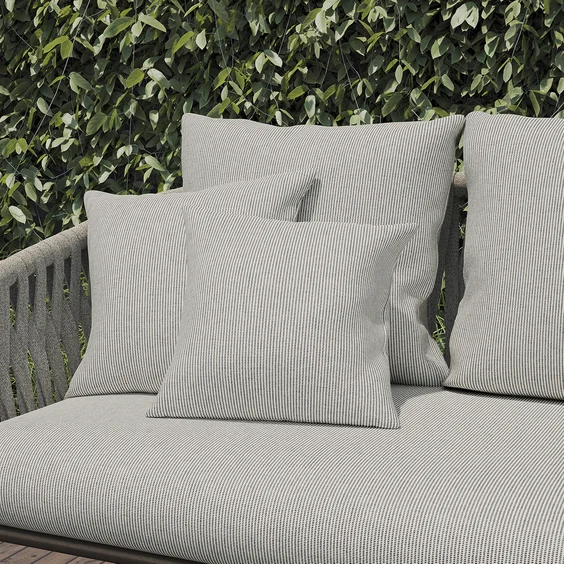
Advantages of recycled olefin textiles
Advantages of recycled olefin textiles
· Zero water is consumed during the production process
· Constructed from 100% pre-consumer textile waste (e.g., fibres, yarns, flawed fabrics, and off cuts)
· Global Recycled Standard (GRS) certified
· Oeko-Tex 100 certified
· UV and stain resistant
· Water repellent
· Bleach cleanable
· Contains no lead-based pigments
· 40 % lower carbon footprint value than virgin polypropylene yarn
· 50 % lower carbon footprint value than virgin polyester yarn
· 70 % lower carbon footprint value than virgin acrylic yarn
· 78 % less oil consumption than virgin polypropylene yarn
· 80 % less oil consumption than virgin polyester yarn
· 85 % less oil consumption than virgin acrylic yarn
ALFRESCO COLLECTION BY JAMES DUNLOP
ALFRESCO COLLECTION BY JAMES DUNLOP
James Dunlop’s Alfresco collection of outdoor textiles includes 100% recycled olefin textiles. Woven in Turkey and double-tumbled for a soft residential handle, these textiles achieve our Eco Standard and are available in an extensive palette of neutrals and decorative, summer-inspired shades.


'Fable' meaning storytelling, evokes our shared desire to pass on stories and memories through textiles. An evolution of our earlier Habitat collection, Fable draws on mid-century modern design with a continued focus on materiality, nurturing a unique sense of personality through the assemblage o...
