

Wallcoverings allow you to add a personal touch to your home interiors by way of colour, texture, and pattern

Journal
How to choose your wallpaper
No longer is paint the only option when creating interiors with personality, there are now a plethora of wallcoverings available to residential and commercial interior designers and decorating enthusiasts.
As an element within an overarching design concept, wallpapers are now easily washable and pair well with painted walls and hard furnishings. The minimal effort of installing modern wallpapers, means you can turn around a room in a day. Furthermore, there are wallpaper options suited to every room in the house, whether that be kitchen, laundry, bathroom, living or sleeping spaces, as well as in commercial projects.
Considersations when selecting a wallpaper
Considersations when selecting a wallpaper
- What size is the space?
- The condition of your walls – they need to be prepped and in good condition before hanging, otherwise imperfections easily show through.
- Ensure you have a few contingency rolls spare.
- Vinyls are the best choice for a novice wallpaper hanger. They are easy to hang and easy to maintain as they are durable, soil resistant, and easy to clean. As an added bonus they’re even easy to remove.
- Flocked papers are good choices for covering walls that have minor surface imperfections due to their raised, velvety patterns. Washable flocks are easier to install than non-washable ones, however, both are expensive and installation requires a professional.
- Always select samples to see how the pattern and colours suit the actual room or use our online visualiser tools to see the design in a digital room.

What does the GSM wallpaper measurement mean?
What does the GSM wallpaper measurement mean?
GSM stands for grams per square meter and is the weight of the paper and/or laminate. A simple paper is typically described by a single number, i.e. 120, 130, 150 GSM, etc. While a laminated wallpaper such as PVC vinyl can be made up of two layers and consequently may be denoted by two figures, such as 80/90, 100/120, 120/200. The first figure denoting the paper weight, the second the vinyl.
Paper is measured by weight because it is impossible to accurately measure its thickness. During manufacturing, papers are processed through a series of rollers that squash the sheets as thinly as desired and regardless of how many times it is squashed, the weight of the paper remains constant. The higher the gsm the higher the density (more weight for the same thickness), which potentially equates to higher quality. Although, there is a lot more to it than that, such as the type of wallpaper.
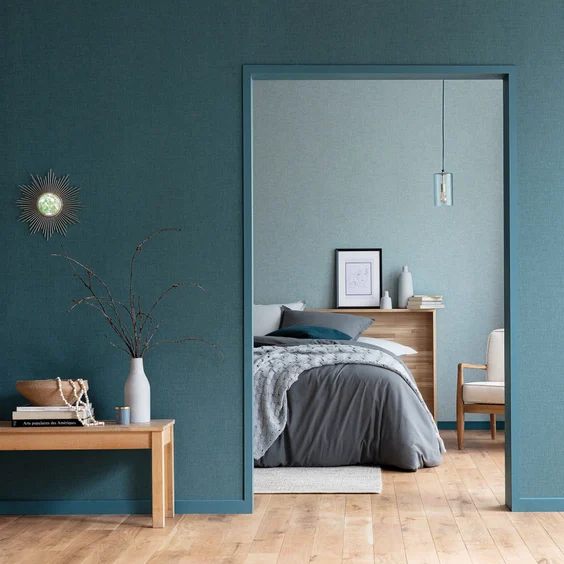
NON-WOVEN UNCOATED SUBSTRATES
NON-WOVEN UNCOATED SUBSTRATES
Non-woven products, often referred to as ‘paste-the-wall,’ do not have a paper base and instead are made of a synthetic blend, making them more dimensionally stable than paper-based options.
Non-wovens tend to have a soft fabric-like feel and have the design qualities of an uncoated paper. The real benefits, however, are in the hanging. Because there’s no expansion when adhesive is applied, there is no need to leave the paper to soak-out like conventional papers and you can paste the wall instead of the back of the paper. This allows it to be hung directly from the roll, making hanging easier and less messy.
UNCOATED PAPERS
UNCOATED PAPERS
An uncoated paper is a wood fibre sheet without a noticable surface coating on it, therefore the face of the paper is fairly rough when compared to coated papers. The paper face is calendered (flattened) to give it a degree of smoothness for printing. Uncoated papers are valued and loved for their soft aesthetic qualities and are best suited to spaces with relatively low foot traffic and no moisture issues, e.g. living rooms, dining rooms, or bedrooms. Generally, uncoated papers can be sponge cleaned with a damp cloth, however, special care needs to be taken not to damage the surface.
COATED PAPERS
COATED PAPERS
A coated paper has the same fibrous backing layer as uncoated paper, but with a very smooth light vinyl coating which can be printed onto.
Coated papers are a good compromise between uncoated and heavy vinyls as an excellent general-purpose wallpapering option for most areas of the home. They can be used in most interiors as the coating gives a reasonable level of protection against moisture, marking, and general wear. They can be lightly sponged with a mild soap if scuffed, however, they cannot withstand rough abrasives, cleaning detergents, solvents, or greasy foods. This, combined with everyday moisture resistance, makes coated papers generally unsuitable for bathrooms, kitchens, and anywhere with high humidity.
PVC (HEAVY VINYL) COATED PAPERS
PVC (HEAVY VINYL) COATED PAPERS
PVC coated papers, or vinyls as they’re more commonly known, consist of a heavy fibrous backing layer with a soft, flexible PVC coating on top. The vinyl wallcovering is printed with the design when it is still in a smooth state; it’s not until after it’s been printed that it is ‘embossed’ to create the textured surface.
Vinyls are hard wearing and hang beautifully, mainly due to the combined weight and strength of the PVC and paper layers. Vinyls have a PVC coating that is moisture resistant and are suitable for high humidity rooms, such as bathrooms and kitchens. They offer some degree of impact resistance and are therefore better suited than any alternatives for to the rough and tumble of family life or high traffic zones. Generally heavy vinyls can be scrubbed clean without damage.
Vinyls perform exceptionally well and are generally much heavier than standard papers because they have two significant layers. Popular in commercial use due to their good fire ratings and durability, their opportunity for use around the home should not be underestimated. Another benefit of vinyl is during redecoration, the PVC top layer is peelable and will pull off, if not in one complete strip, at least in big pieces. Once this is removed the backing layer can be made wet and easily scraped off.

What about Design?
What about Design?
One of the most important factors in choosing wallpaper is selecting a design you like but you will need to make sure that the print/pattern works in the space that you plan to cover. Here are some basic style tips:
- Any vertical design element (stripes/patterns) will elongate a space, so the ceiling appears higher.
- Conversely, horizontal design elements will provide a wide perspective to the room, lowering the ceiling’s appearance.
- Large patterns generally overpower smaller rooms as they shrink the perspective, overall the look is better achieved in a larger space.
- A mini-print or a paper with a small pattern or geometric design suits smaller walls.
- Colour is important with darker colours effectively shrinking a room, while wallpapers with a light background expand the perception of the room.
Use bold wallpapers to embrace colour and pattern in your space. Whether your interior style favours retro botanical prints, maximalist geometric forms, or stylised folk art in a sun-drenched palette, a statement wallpaper is sure to uplift and energise your scheme. Read on to discover our tips f...
