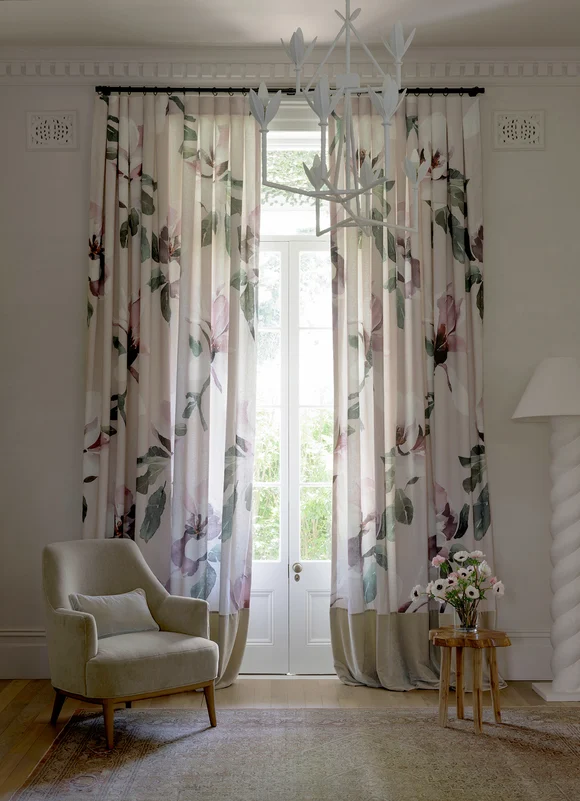
Now more than ever people are seeking to escape from our digi-centric world and find serenity in their bedroom. Therefore, getting the bedroom right – specifically the bed – is very important and custom-made bedding and bedheads are key elements to consider.

Journal

Bedhead in Bespoke colour Topaz, bedcover in Bengal Tiger colour Gold, cushions in Leopardo colour Tobacco, Bengal Tiger colour Gold, Bespoke colour Topaz, and Monarque colour Aquamarine | Catherine Martin in the Las Vegas Hotel Suite on set of Elvis | Photograph by Hugh Stewart

HEADBOARD IN BESPOKE COLOUR SIENNA & SQUAB IN BESPOKE COLOUR MARTINI BY CATHERINE MARTIN BY MOKUM | Interior by Nyree MacKenzie Design, PHOTOGRAPH BY ANDY MACPHERSON
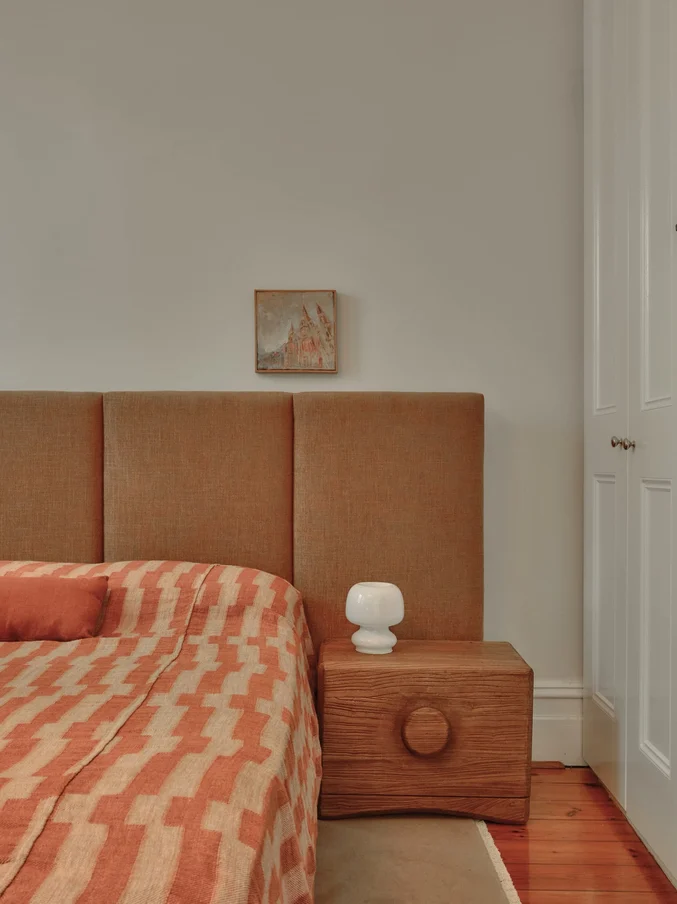
Headboard IN SAHEL COLOUR ROSE GOLD BY MOKUM | INTERIOR BY ALYSSA OWENS DESIGN, PHOTOGRAPH BY JACK CARLIN
Accessories | Bedding & bedheads
Hems, piping, & flanged cords
Hems, piping, & flanged cords
Bedcovers are generally either quilted or unquilted; it is important to firstly ascertain your client’s preference and then determine the appropriate style. While details will vary between manufacturers, the standard options are:
• A standard hem is an over-locked and turned hem which is usually top-stitched 5-7cm from the base of the bedspread.
• A blind stitched hem creates a very clean look without an obvious hem. This is not a robust hem and should not be used in commercial applications.
• A flat padded hem is made separately, usually in a contrasting fabric of 5-7cm finished width, and attached.
• A rolled hem is an attached hem that is made into a firm roll of approximately 8-10cm diameter, often in a contrasting fabric.
• A ruched hem is also an attached hem that is ruched/gathered, creating a soft and very traditional look.
• Piping can be either flat or filled with cord. It is normally sewn between two fabrics, either above an attached hem or around the top of a fitted bedspread, or sewn around the bottom edge of a bedspread.
• There is a wide selection of flanged cords available; these are sewn into the bedspread in the same way as piping.
Bed Valances
Bed Valances

Bed valance & bedhead in Mendochino by Designs of the Time | Palazzo Petrvs interior by Giuliano Andrea dell’Uva | Photography by Nathalie Krag and sourced from Pinterest
Custom-made valances are popular because of the variety in bed base heights, which mean ready-made valances often do not fit well. Generally used with cap-style bed and duvet covers, valances are also used under full-size bedspreads to conceal the bed base. There are three basic styles:
• A pleated valance can feature pleats as often as required around the bed, but generally in the corners only.
• A quilted valance usually features channels running vertically or horizontally in a variety of widths. A quilted valance does not require ironing after washing.
• A wrap-around with straight sides is a fitted style.
Finer points to check with your manufacturer:
• It is standard to bring the valance around the top of the bed by 20cm on each side or make the valance four-sided, this ensures it sits on the bed well without slipping down.
• It is standard to put a 10cm band of the main valance fabric around the top broad deck of the valance to ensure the polycotton centre never shows.
• We recommend blind hemmed or lined and bagged out valances. If the valance is not sitting completely straight on the bed it is very obvious with a top stitched hem.
• We recommend the fabric used on the top deck of the valance and the back of the quilting be polycotton so that the valance does not shrink when washed.


Duvet covers
Duvet covers

Bedhead & bedding in Satori Stonewash colour Petrol by Mokum | Interior by Hayley Bridget Interiors | Photograph by William Jess Laird and sourced from Pinterest
Despite the huge selection of ready-made duvet covers available, a custom-made duvet will ensure your client has a bespoke piece which complements and reflects their interior.
There are standard measurements for each bed size, to ensure they fit the inners available. However, to give a very generous look it is also common to use a duvet one size larger than the actual bed size. It is common to use the same fabric on both sides, but to reduce the cost a coordinating bed sheet can be used on the reverse. We recommend using a polycotton sheet, so it doesn’t shrink when washed, and is one size larger than the duvet.
As most bedspreads are cleaned regularly, the top fabric should be a polyester, polycotton, or pre-shrunk cotton and the lining should be stable polycotton only. Residential clients often request linen, silk, or viscose fabrics for bedspreads. These can be used successfully but your client should be advised of the difficulty of cleaning and the likelihood of fabric movement with changes in temperature and humidity.
There are three basic styles of duvet cover:
• A flanged valance is created either by top stitching or attaching a contrast flange.
• Usually, a contrast fabric is used for a piped valance.
• A plain valance is top stitched around the square edges to avoid rolling.
• Duvets may utilise buttons, zips, velcro, or domes. However, buttons are prone to breaking in the washing process, please consider this when selecting a type of closure.


Headboards
Headboards
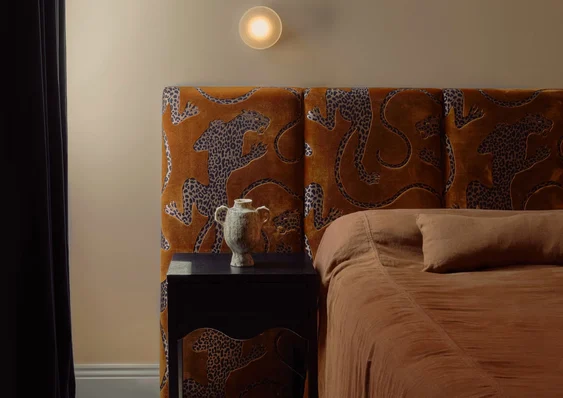
Zenn Design Headboard IN Panthera COLOUR Gold BY Catherine Martin by MOKUM | INTERIOR BY ALYSSA OWENS DESIGN, PHOTOGRAPH BY Elisa Watson
The headboard is a piece of furniture that attaches to the head of a bed and is often balanced by an ottoman at the end of the bed. Whether in a commercial or residential environment, bedheads are a popular way to complete a bedroom scheme.
Historically a headboard served to isolate sleepers from cold drafts in poorly insulated buildings and thus were commonly made of wood, which is less thermally conductive than stone or brick. Today headboards serve chiefly for aesthetic and utilitarian functions, such as keeping pillows from falling off the bed and providing support and comfort whilst sitting up in bed. They may also include storage solutions for books and personal items, and conveniences such as lights. Headboards used in hospital beds and aged care facilities may incorporate critical care functions.
Many choose to upholster their bedheads, with either heavy drapery or upholstery fabric and there are many different styles available.
When choosing an appropriate fabric to upholster the bedhead, be sure to consider its washability as an upholstered bedhead cannot be removed to be washed or dry cleaned. Therefore, a fabric which can be spot cleaned, a removeable slip cover, or those enhance by FibreGuard stain resistance would be an ideal solution.


It’s an age old saying that a window unfurnished is a window unfinished, but there are many decisions to be made when investing in custom-made curtains. Firstly, specifying a fabric which meets the client’s aesthetic, performance, and budget requirements, then selecting an appropriate heading sty...