

Our definitive guide to sheer draperies

Journal

Patterned Sheer | Eucalypt by James Dunlop

Sheer | Cavalier by James Dunlop
Delicate, light, translucent sheers
Sheer curtains have evolved to bear little resemblance to the doily-esque net curtains of old. Florals and lace have been usurped by a desire for texture – be that fine, chunky, or smooth – with a lustrous or organic look.
The romance of sheers is in their ability to softly filter light into homes, but their continued popularity in interior design is due to their practical, functional prowess.
An architectural evolution
An architectural evolution
The way we furnish our interiors is informed not only by trends, but by the architecture of the structure which surrounds us.
Victorian and Edwardian architecture of the early 20th century led to the construction of homes with many small rooms featuring fireplaces and sash or bay windows. Following WWII and the subsequent baby boom, the housing expansion of the 1940s-1960s created ‘suburbia.’ To house a lot of people quickly, there was little time for architectural creativity – stud heights were lowered and small windows and kitchens were installed.
European innovators such as Mies van der Rohe, Le Corbusier, and Frank Lloyd Wright simultaneously inspired a new generation to pioneer modern design styles across the Americas and Australasia. Their influence occurred alongside improved home insulation and cultural changes to our lifestyles which placed greater emphasis on expansive windows, high studded ceilings, and open plan living.

Envoy 2 by James Dunlop
Technological advancement
Technological advancement
Historically, woven fabrics were limited by the loom sizes available. Initially woven on two bed linen looms at 280cm wide, drapery looms evolved to create an industry standard of 310-320cm wide.
Further advancement of loom capacity enables mills to weave extra-wide 350cm drapes. Reducing the need to join seams by creating ‘continuous drapery’ which takes nothing away from the ambiance of a space and the vistas beyond.
SHEER, SEMI-SHEER, & MAIN DRAPE
SHEER, SEMI-SHEER, & MAIN DRAPE
Sheer, semi-sheer, and main drape are key terms used to differentiate the opacity and weight of textiles. The weight is measured in grams per square metre (GSM) i.e., how many grams does one square metre of fabric weigh? In general, thicker textiles are denser and therefore have both a higher GSM and less opacity.
A sheer is something you can see through, either because the fabric has a very fine construction or because it has a loose construction with open fibres. Cavalier by James Dunlop is a sheer fabric of 309 GSM.
A semi-sheer is more densely woven with some light transmission and luminosity. Rather than seeing directly through the fabric, you will see shapes and shadows. Gouache by Mokum is a semi-sheer fabric of 509 GSM.
The main drape is a solid face fabric in a dense weave, often featuring patterns and prints. Satori Stonewash by Mokum is a main drape fabric of 734 GSM.


TO LINE OR NOT TO LINE?
TO LINE OR NOT TO LINE?
In the eyes of our Designer Brands Specialist, Blair Borland, the answer is always yes. “The key to any curtain is the lining, it’s the most important part to get the best result,” says Blair. A lining is invaluable in extending the life of all curtains and soft furnishings in your home, but especially delicate sheers.
Linen is an industry favourite, whether that be natural or a linen-look. “The magic of linen is in the translucent quality – you see its texture as you look through it – but using a blackout lining behind it can make a linen look flat and lose its dreamy effect.”
However, by incorporating a plain, inexpensive polyester voile lining the curtain will retain its ethereal quality and the linen will be protected from UV damage. “A good trick is to have a plain voile, like De Mundo II, as a detachable lining against a sheer. When the time comes to replace that component you can keep the original face fabric, which adds value to the face fabric too.”
When lined, sheers can become a main drape. This lighter look is especially popular in warm, coastal climates like the upper North Island of New Zealand, or in New South Wales, Queensland, and Western Australia.
Read more: When a lining is not a lining, but so much more...
Read more: How to choose the right lining


CURTAINS AND BLINDS
CURTAINS AND BLINDS
Roller blinds are a great alternative to ‘double tracks’ which are constructed with the lining on the back track, and the sheer on the front. “We don’t ever want the face fabric to be unlined, which is what the double track is for. As soon as the linen sheer is pulled across into the sun, the UV is doing its work on it. I would always recommend a lined sheer and a roller blind, or some type of filter blind. It’s the biggest protection you can have because roller blinds protect the upholstery fabric on your sofa etc. too – it’s a double whammy effect.”
“Lots of clients buy blinds because they’re an economical option but come back later to add sheers because blinds are very hard and clinical, especially in the main living room or primary bedroom. The sheer adds softness, texture and movement to a room, catching the light as they billow and move with the breeze.”
To protect your home from excess heat and light but maintain the aesthetic of a floaty linen sheer, Blair suggests lining the sheer curtain with a plain voile, then installing venetians, shutters, or roller blinds as the blackout component. “The blind can nestle inside the window and almost disappear, but it has the functionality to control the light at day or night.”
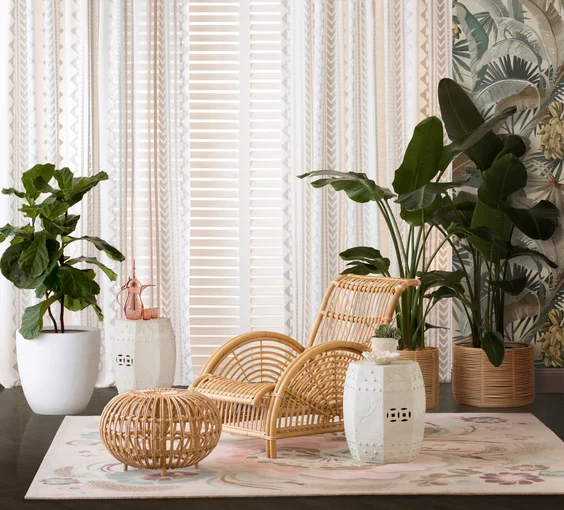
Aleuj by Mokum
Sheers work particularly well in modern architectural and coastal homes, softening windows and preserving privacy without interfering with the view. Through the addition of texture, sheers bring a human element to industrial spaces dominated by hard materials and add femininity to the room. Additionally, sheers aid in protecting interior furnishings from harsh UV rays and regulating the temperature by day and night.
Explore our complete range of sheer draperies or reach out to your local showroom for more information.
One of the earliest forms of decorative surface embroidery, crewel (or crewelwork) derives from the Welsh word for wool and dates back over one thousand years. Traditionally crafted with thick, worsted woollen yarn on a sturdy linen twill ground, crewel encompasses various stitches from simple ch...
