


Palm Springs, Beverly Hills, and Bengal Tiger by Catherine Martin by Mokum

Journal
Weaving a jacquard velvet
Jacquards are intricate fabrics woven on jacquard looms; a machine patented by Joseph Marie Jacquard in 1804. The term jacquard indicates a series of raised motifs woven into a pattern using a jacquard loom, as opposed to describing a specific design.
These weaves can be highly textured or feature intricate designs, and while traditional styles are brocades and damasks, they can be woven in almost any yarn – from lustrous silk and viscose to drier linen and cotton fibres. Jacquards are unique amongst textiles because any decorative accents are incorporated into the weave instead of being printed or dyed onto the surface of the fabric, therefore they are durable, resistant to wrinkling, and pleasant to touch.
We spoke to the craftspeople who weave Palm Springs, Beverly Hills, and Bengal Tiger by Catherine Martin by Mokum to understand how these luxurious jacquard velvets are constructed.

Moonlight Memphis collection by Catherine Martin by Mokum
JACQUARD LOOMS & VELVET PRODUCTION
JACQUARD LOOMS & VELVET PRODUCTION
Revolutionising textile weaving and heralding the Information Age, the jacquard machine was inspired by the pianola (a self-playing piano) and a predecessor to modern computer coding.
The machine is fitted to the loom and controlled by a series of cards punched with multiple rows of holes which relate to the motif and regulate the raising of stationary warp thread mechanisms. The loom’s patterning mechanism can control the interlacing of up to several hundred warp threads, therefore enabling complex patterns to be woven into textiles. The introduction of electronic jacquard looms in the 1980s and subsequent computerization has made jacquard production more efficient and resulted in higher quality fabrics.
Historically, plain velvets were produced on a heddle or treadle loom and, until the invention of the jacquard loom, figured or patterned velvets were produced on a drawloom. The process of weaving velvet is similar on each loom. The velvet is woven as two face-to-face cloths joined by the warp pile thread, as it comes off the loom the combined fabric is separated by a knife edge and the fibrous cut ends of the yarn form the textured surface of the ‘cut warp pile’ fabric. However, because the looped or pile warps require approximately six times more thread than the ground weave, the extra length is wrapped around a separate warp beam behind the loom.

Illustration of a jacquard loom & photograph of punch cards | Images sourced from Pinterest
Palm Springs
Palm Springs
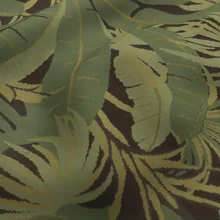
We revisited the original La Palma artwork when creating Palm Springs; removing the iconic bananas from our print design and using a combination of loop and cut pile techniques to capture the tropical foliage in viscose and polyester yarns. Palm Springs is woven on a four-frame velvet loom, capable of weaving four unique pile colours at once, while maintaining a concealed ground.
The ground is woven on the warp beam utilizing the dobby technique, while the pattern is created by the pile yarns through the jacquard technique. The yarn hanks (coiled or wrapped units of yarn) are converted into bobbins which are organised on the creel according to the pattern and colour placement at a particular distance from the back side of the loom. The interplay of multiple yarns and colours must be continuously and precisely managed throughout the production process, as a small error can affect the final appearance of the fabric.
The beauty of Palm Springs is in its large, detailed foliage. Weaving such designs requires the special attention of master craftspeople who prepare the looms over a period of two days and execute the intricacies in the design with precision, limiting production to less than ten metres per day.



Beverly Hills
Beverly Hills
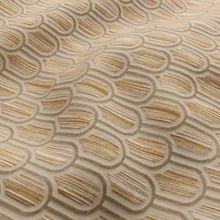
The peacock feather motif of Beverly Hills is constructed in multi-coloured stria yarns which offer a unique depth of colour. Each motif is surrounded by cut velvet and set on top of a fine ottoman weave background.
The stria effect is achieved by dying the yarns as many times as there are colours in each hank. In the case of Beverly Hills there are four colours in a single hank, so each hank is divided into four sections which are assigned different colours. The first colour is dyed while the balance colour portions are tied with threads; this process is repeated until all four colours have been dyed. The rich depth of colour within each motif is representative of the time and craftsmanship involved; on average, stria yarn dyeing takes four times longer than regular yarn dyeing.
Once dyed, weavers utilise the same jacquard velvet loom as that of Palm Springs. However, because Beverly Hills is crafted from these specially dyed yarns the loom takes an extra two days to prepare and weaves only one metre of fabric per hour.


Bengal Tiger
Bengal Tiger
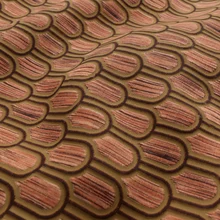
Our decadent Bengal Tiger skin receives its sense of dimension from the spine motifs which are recessed within the viscose pile and edged with a fine shadow line. This lustrous viscose is sometimes referred to as faux-silk due to is silk-like appearance and soft, smooth feel.
Woven in the style of a Lyon velvet which is characterised by its densely woven, stiff pile, Bengal Tiger is a high-density textile requiring a jacquard loom with approximately 20,000 threads. Whilst the pile yarns are piece-dyed, the ground is yarn-dyed, thus additional care and consideration is required during colour development to ensure the shades coordinate and are balanced between the two areas.
This velvet is referred to as a double cloth as two layers are woven face-to-face at the same time. The pile ends are woven to allow movement between the two sides, passing within a gap of approximately 0.6cm. The pile ends are cut by a reciprocating knife blade to separate the pieces of cloth as it comes off the loom and the pieces are rolled onto individual take-up beams.
An interesting result of weaving our patterned Bengal Tiger in this manner is that the cut layers form a mirrored reverse of each other. Therefore, when ordering large quantities of this textile it is important to cut from the same roll to guarantee consistency in both the design’s appearance and colour, as it is a piece-dyed product.


Learn more about the secrets of velvet in our previous article For the love of velvet and explore our entire range here.
Digital technologies have innovated all aspects of the interior design industry. Enabling designers to discover hard and soft furnishings and finishes from all corners of the globe, which can be presented to clients through digital mood boards and visualisations in a myriad of colors and textures...
