


A short textile history of plaids, checks, and tartans

Journal
A checkered past
Plaids and checks are classic textile designs that can be identified by the complexity of the pattern and their unique historical origins. In this article we decipher these terms, the differences between tartan and Scottish tartan, and identify these patterns within our expansive textile range.

Plaids vs Checks
Plaids vs Checks
A plaid is a printed or woven fabric composed of an array of intersecting vertical and horizontal stripes in varying widths and colours. In contrast to checks, plaid fabrics are more intricate, featuring asymmetrical or irregular patterns.
Originating from Gaelic, the term ‘plaid’ referred to a large woolen blanket thrown over the shoulder as part of traditional Highland dress. As language has evolved geographically, North American usage of the term ‘plaid’ has come to define any style of checkered or tartan-like fabric.
Comparatively, checks feature uniform and repetitive compositions of symmetrical horizontal and vertical stripes in two or three colours which intersect to form squares. Appearing throughout the world in many variations, checks are usually constructed from lightweight cottons and linens as opposed to the more robust fabrics, such as wool, used to weave plaids and tartans.
Scottish Tartans
Scottish Tartans
Whilst all tartans are plaid patterns, not all plaids are tartans.
According to the Scottish Register of Tartans, 'A tartan is a design which is capable of being woven consisting of two or more alternating coloured stripes which combine vertically and horizontally to form a repeated chequered pattern.’ This repeated pattern is known as the ‘sett’ of the tartan.
Because the sequence of warp colours and widths is repeated in the weft, a solid block of colour is produced when matching warp and weft threads cross, whereas when unmatched colours cross they produce a ‘half-tone’ mixture. Tartans are traditionally woven in a 2/2 staggered twill weave structure which produces a distinct diagonal pattern, particularly noticeable in half-tone areas.

Woollen cloth fragment from the Falkirk Hoard, discovered 9 August 1933 in Bell's Meadow, Falkirk, Stirlingshire. C. 230 AD. | National Museums of Scotland
The earliest example of Scottish tartan dates to 230AD, uncovered in the Falkirk Hoard in the mouth of a pot containing Roman coins. Historically, each community would have acquired tartans from their local weaver which were dyed with plants such as gipsywort for a vibrant green, heather for yellow, deep green, or orange depending on their treatment, and blaeberries for purple. Wealthier clientele could request exclusive, imported dyes such as cochineal or indigo to create diverse tartans.
These local tartans were known as District Tartans, with the idea of Clan Tartans coming to the fore following the 1745 Battle of Culloden and the British governments 'Disarming Act' which forebode the wearing of tartan for the next 36 years. Scottish tartans are now formally recorded in the Scottish Register of Tartans, ensuring accurate archiving and reproduction of these culturally significant textiles.
Tartan (Plaid)
Tartan (Plaid)
Plaid –
Technically, tartans are woven with the same colours in the same order in the warp and weft, whereas plaids feature different colours in the warp and weft, or a different balance in the yarn order i.e. the order of colours on the warp or weft are not symmetrical.
However, confusingly, the terms ‘tartan’ and ‘plaid’ are used interchangeably within the industry.
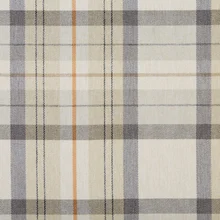


Madras
Madras
Plaid –
Madras are vibrant plaids, woven in lightweight fabrics such as cotton.
As early as the 13th century, people in the southern Indian area of Madras (now Chennai) wore checkered garments called lungis (similar to a sarong) which were naturally dyed and woven from muslin cloth.
Buffalo
Buffalo
Plaid –
Resembling an over-scaled, often black gingham, buffalo is a plaid masquerading as a check. Woven in a 2/2 twill weave structure, buffalo features large crisscrossing stripes in two colours to produce bold, two-tone squares.


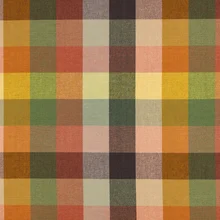
Gingham
Gingham
Check –
Primarily a fashion fabric, gingham (also known as Vichy) is a simple checked design that generally consists of crisscrossing, even stripes in two colours (usually one of which being white). Due to the over-lapped nature of the weave, gingham appears to have three colours.
Windowpane
Windowpane
Check –
Also known as French windowpane or Brunswick check, the grid of thin, widely spaced, coloured lines on a contrasting, solid ground resembles windowpanes.

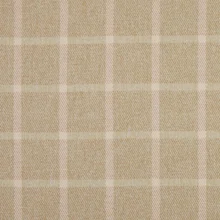


Tattersall
Tattersall
Check –
Tattersall features thin, regularly spaced coloured bands against a white background. Whilst similar to windowpane, it is identified by the two sets of squares overlaid upon each other which create a multidimensional effect.
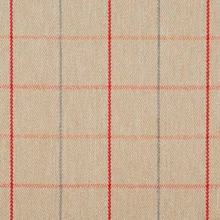
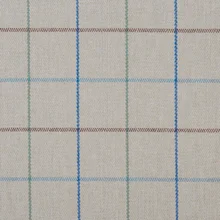


Checkerboard
Checkerboard
Check –
One of simplest checks, the checkerboard design incorporates threads in two contrasting colours and resembles the chess board.


Houndstooth
Houndstooth
Check –
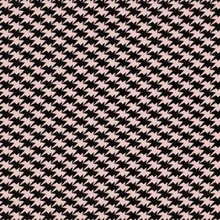
Houndstooth is named for the pattern of broken or uneven checks which resemble a dog’s tooth. The design is created because of the placement of colours in the warp and weft combined with where they appear in the weave structure. Unlike most basic checks which are constructed in a plain weave, houndstooth is generally a twill weave.

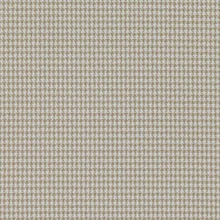

James Dunlop’s Habitat Collection fosters slow interiors with an appreciation of quality and craftsmanship, presented through an inherently modern sensibility. Celebrating the cherished objects collected during travels and personal experiences which narrate the story of an interior and bring char...
