
Digital printing is the latest printing revolution. It can be used to produce large scale designs, designs with many layers of colours, and designs that are not restricted by the roll width in terms of their pattern repeat. Designs can also be digitally printed onto PVC vinyl substrates which are suitable for use in high-moisture areas such as kitchens and bathrooms.

Journal

Solid PVC Vinyl | Se Cacher by James Dunlop
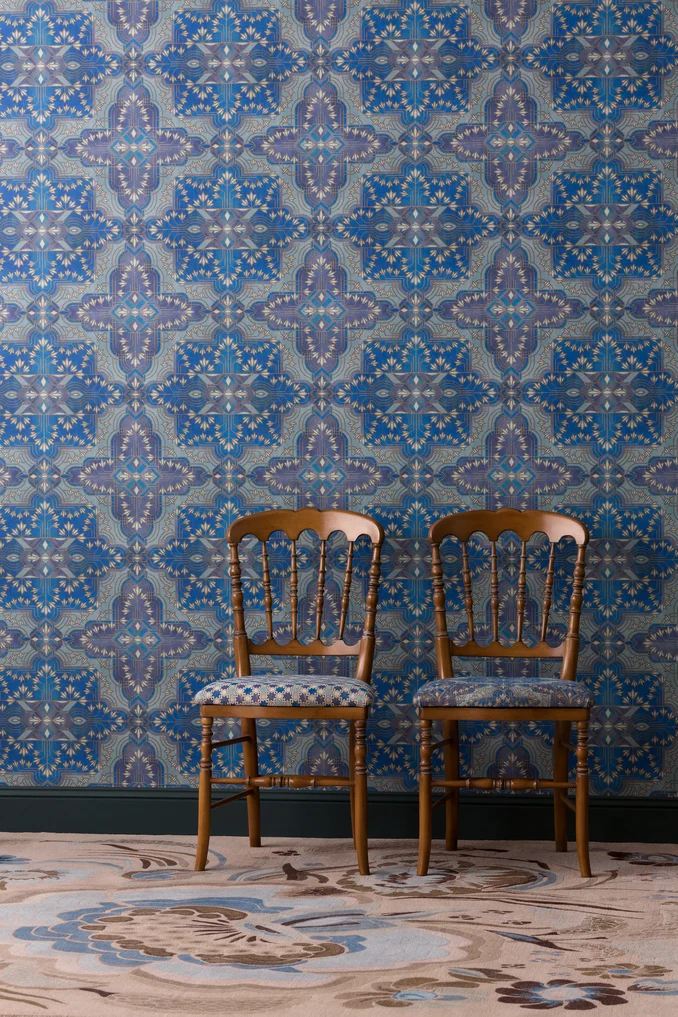
Digital printing onto embossed vinyl | Majorelle Wallpaper colour Sapphire by Catherine Martin by Mokum

Solid PVC vinyl | California Dreaming Wallpaper by James Dunlop
Modern wallpaper printing techniques
DIGITAL PRINTING
DIGITAL PRINTING
Digital printing is the latest printing revolution. It can be used to produce large scale designs, designs with many layers of colours, and designs that are not restricted by the roll width in terms of their pattern repeat.
The printer converts a digital image file into pixel data, to be printed onto photosensitive media (photographic print paper). The paper is exposed as it traverses under lasers or light emitting diodes (LEDs), then fed into a lightproof container and taken to a ‘processor’ where it is ‘developed’ via a series of photochemicals, emerging dry and ready for the next step, lamination.
Lamination is the process of coating the photographic media with a thin, protective, UV resistant sheet of plastic to protect the light fastness of the image and guard against scratches, fingerprints, and moisture damage.
Digital printing can be accomplished using various methods:
• Dry Transfer Printing
• Dye-Sublimation (Thermal Transfer) Printing
• Inkjet Printing: Printing that fires extremely small droplets of ink onto paper to create an image.
• Laserjet Printing
• Electrostatic Printing
• Grand Format Printing
• Digital Photographic: When properly produced, the result is a true photographic reproduction of your digital file, free of visible dots.

Digital printing onto embossed vinyl | La Palma Wallpaper colour Hollywood by Catherine Martin by Mokum
HEAT EMBOSSING PRINTED VINYLS
HEAT EMBOSSING PRINTED VINYLS
Heat embossing vinyl transforms a smooth plastic wallcovering into a three-dimensional one. It is a general misconception that the paper is printed in the conventional way and then a thin layer of PVC (polyvinyl chloride) is spread on the surface afterwards for protection; this is not the case.
Vinyl wallpaper begins the print process when a smooth layer of PVC is applied to a backing layer, normally paper. At this stage the solvent-based ink pigments adhere well to the PVC but it is not until the whole sheet has been heat embossed that it is "fused" – effectively making the ink part of the coating itself.
Embossing is not part of the printing process but occurs in three stages. Heat is used to soften the PVC layer before a textured steel roller is impressed into the PVC, then cooled to aid in forming the new shape.
Types of vinyl wallcoverings
Types of vinyl wallcoverings
Solid PVC vinyl is heated and squeezed between pressure rollers to emboss the desired pattern.

Solid PVC vinyl | Amazonia Wallpaper by James Dunlop
In blown PVC vinyl, the vinyl layer contains a "blowing agent" which is a heat activated ingredient that expands rapidly when it is warmed up, making a thick foam-like layer. This is useful in creating a very deep emboss without using an expensive thick solid vinyl.
Blown PVC is subcategorised into two types:
To create mechanically blown vinyl the thick foam-like layer is squeezed between pressure rollers to crush and emboss the desired pattern.
To create chemically embossed blown vinyl the expandable "blowing agent" doesn’t need pressure rollers to emboss the design, instead the printing ink contains a chemical inhibitor that neutralises the expandable blowing agent. Therefore, when heated the pattern (created with the chemical inhibitor/printing ink) doesn't expand but the remaining surface area does, creating an embossed look.
Discover traditional wallpaper printing techniques such as woodblock, flocked, or grauvre in our previous article, and learn more about maintaining your wallcoverings here.
The first known method of wallpaper printing was recorded in 1509. Prior to this, plain paper was pasted to the wall to be drawn on and coloured in by artists. In this article we outline the plethora of design styles and printing techniques that are, or have been, commonly used for the mass produ...
