The first known method of wallpaper printing was recorded in 1509. Prior to this, plain paper was pasted to the wall to be drawn on and coloured in by artists. In this article we outline the plethora of design styles and printing techniques that are, or have been, commonly used for the mass production of wallpaper over the last 500 years.

Journal

Gravure Printing onto non-woven substrate | Royal Peacock Wallpaper in Vintage White by Catherine Martin by Mokum

FLOCK (BLOCK PRINTED) | Link (Flock) Wallpaper by James Dunlop Indent

FLEXOGRAPHIC PRINTING | Buzzed Off Wallcovering by Villa Nova
Traditional wallpaper printing techniques
BLOCK PRINTING
BLOCK PRINTING
For 300 years, before the introduction of the printing press, block printing was the only "real" means of printing wallpapers.
Designs are created by artisans who ink carved wooden blocks and press down onto paper. The accuracy and strength of colour is effectively governed by the printers "gut feeling" of how much pressure to apply to the back of the block.
After each individual colour has been laid, the paper is hung for 4-5 hours to let the thick water-based inks dry before the next colour can be applied. Once all the colours have been printed the wallpaper is PVA lacquered for protection, before being manually trimmed and individually hand wound.
FLOCK (BLOCK PRINTED)
FLOCK (BLOCK PRINTED)
Believed to have been introduced in the late 17th century, flock wallpapers are traditionally produced using the block printing technique. The difference being that one, or occasionally two, of the colours are substituted for rayon or wool fibres, giving the print a soft velvet-like feel.
The paper used for flock printing is generally 25-35% heavier than standard wallpaper, to accommodate the heavy nature of flock which a standard paper could not support.
PAN (TROUGH) PRINTING
PAN (TROUGH) PRINTING
Pan printing was introduced in the mid-1500s as a means of evenly colour washing the background of the wallpaper before block printing − a process that was previously done by hand.
The ink sits in an elongated trough with a sieve-like base same the width as the paper. The sieve allows ink to pass through and cover the paper, which is rolled underneath the trough at a controlled speed. It is the fluidity of the ink that governs how much colour is applied to the paper.
Whilst pan printing is a process in its own right, it is more often than not used as a backdrop to other processes, the most common of these being block printing.
SURFACE PRINTING
SURFACE PRINTING
Invented in 1839, surface printing was the only mechanised means of printing wallpaper for the next 100 years. It was responsible for making wallpaper available to the masses and its immediate success marginalised block printing.
The machine consists of a large drum cylinder made of a very hard ceramic rubber, approximately 1.5 m in diameter, with 12-20 print "stations" spaced around the circumference and paper is fed around all printing stations. The area you don’t want to print is cut out from the surface, leaving the printing surface "proud" on the cylinder. Water-based inks are used because they don’t evaporate in the same rapid way as a solvent, thus the ink is still wet when the paper reaches the next printing station. This process of wet ink falling on wet ink creates an effect of colours lightly “bleeding” into each other, giving the quintessential soft visual finish of this printing process.

SURFACE PRINTING with metallic inks and foil | Metropolis Wallpaper by Catherine Martin by Mokum
FLAT-BED SCREEN PRINTING
FLAT-BED SCREEN PRINTING
Introduced in the early to mid-1940s, flat-bed screen printing utlises a flat rectangular shaped frame with a mesh stretched across it. To create a design, it is necessary to completely coat the screen with a photosensitive polymer before placing the stencil onto the mesh, then being "photo-exposed" under special lighting to harden the polymer into an impenetrable lacquer. The screen is placed face down onto a length of wallpaper, and the thick water-based inks are applied to the back of the screen. The inks are drawn across the mesh using a rubber squeegee, forcing the ink through the areas of open mesh in the shape of the design.
Once the colour is laid, the screen is lifted and moved along to the next position, where the process is repeated. It is important that the inks are allowed to fully dry before any subsequent screens are placed on top.
NOTE: Traditionally screen printing was called "silk screen printing" because the stencil screens were made of silk. This term has carried into modern times despite the fact nylon is now commonly used as opposed to silk.
ROTARY SCREEN PRINTING
ROTARY SCREEN PRINTING
Introduced soon after flat-bed screen printing, in the early 1950s. The process creates a similar look to flat-bed screen printing, however, it can print a continuous web of moving paper (< 3000m), as opposed to the limiting length (normally 30m) of flat screen printed wallpaper.
NOTE: Whilst rotary screen printing may, in principle, be similar to flat-bed screen printing, it is significantly cheaper due to gained efficiencies in continuous print manufacturing.
FLEXOGRAPHIC PRINTING
FLEXOGRAPHIC PRINTING
Introduced in the early 1960s and similar to surface printing in that it’s a relief type print process that uses a relatively soft rubber print cylinder with a "raised" printing surface. Print stations are equally spaced around the outside of a large cylindrical drum that carries the paper, face out, around it by a series of rollers. In keeping with most relief type print processes, the cylinders lay down a single flat colour, however, advances in technology have resulted in flexo rollers that can now produce a reasonable degree of tonal work.
GRAVURE PRINTING
GRAVURE PRINTING
The design screen used for gravure printing is a highly polished engraved cylinder with a thinly laid, soft copper coat wrapped around it. This copper coating is engraved with the desired design through creating microscopic cells/holes that fill up with ink.
It is not uncommon for there to be tens of thousands of cells per square inch. Excess ink is scraped off the cylinder surface before the cells release their cargo of ink onto the paper. The depth and width of each cell determines how much ink is applied to the paper and subsequently the strength of colour. The shallower the cell, the lighter the colour and vice versa. The major benefit of gravure printing is the ability to print fine tonal work and graduation of colour using a single cylinder.
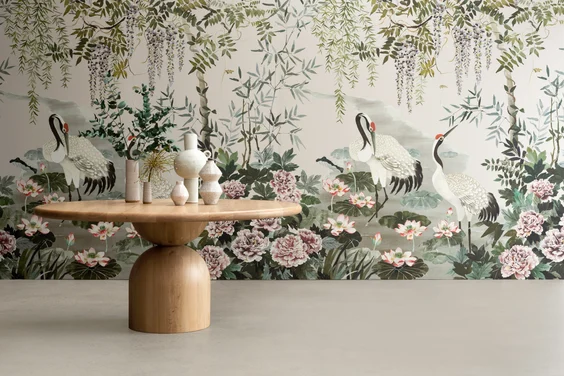
Gravure Printing onto non-woven substrate | Mizu Garden Wallpanel by Mokum
Explore the contemporary wallpaper printing techniques of digital printing and heat embossing vinyl wallpapers in our next article, covering modern wallpaper printing techniques.
A shared venture between 12 interior design companies, 159Design opened in Auckland’s Grey Lynn in 2021 and in late 2022 it was time to dress up and celebrate the city's newest interior design destination.